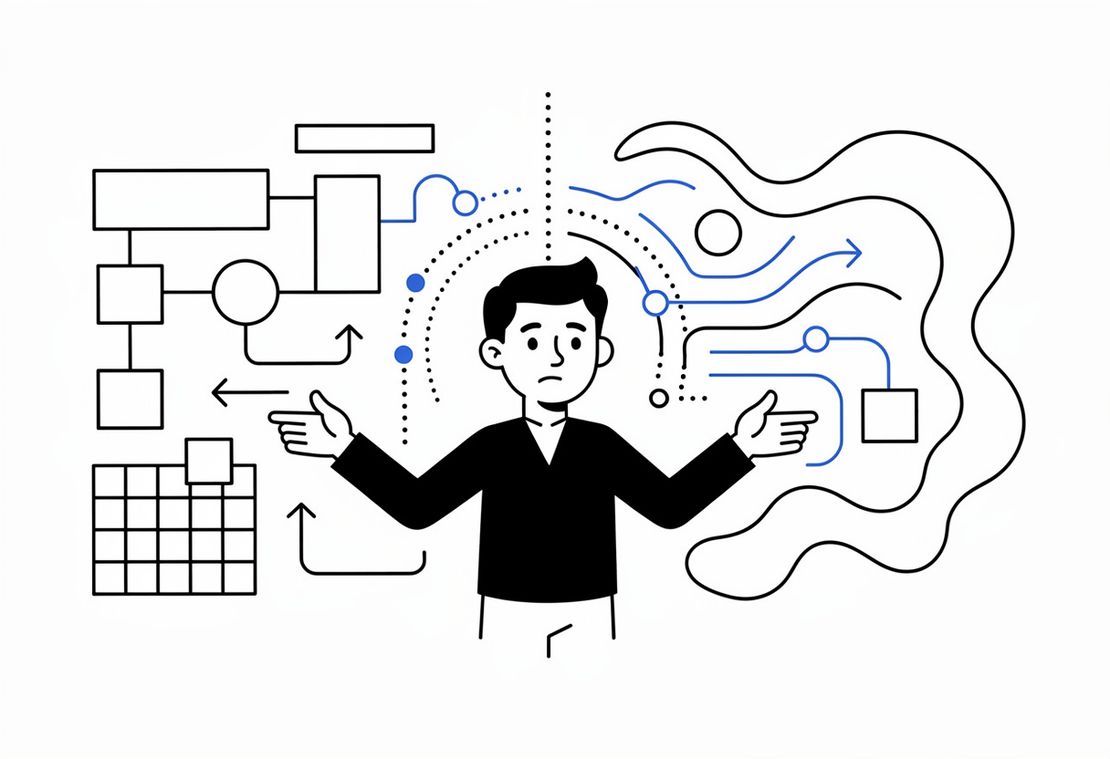
Companies hear about AI agents and automation platforms. They get excited. They jump straight to building complex custom solutions or buying expensive software. Six months later, they’ve spent tens of thousands of dollars and nobody’s using what they built.
There’s a better way to think about AI implementation, and it comes down to understanding three distinct levels of solutions. Each level serves a different purpose, requires different resources, and delivers different results. The mistake most companies make is starting at the wrong level.
Here’s the framework that separates successful AI implementations from expensive failures.
The Problem: Starting with the Roof
Think of it like building a house. You can’t start with the roof. Yet that’s exactly what happens with AI. Companies try to build custom AI agents when their employees don’t even know how to use ChatGPT effectively.
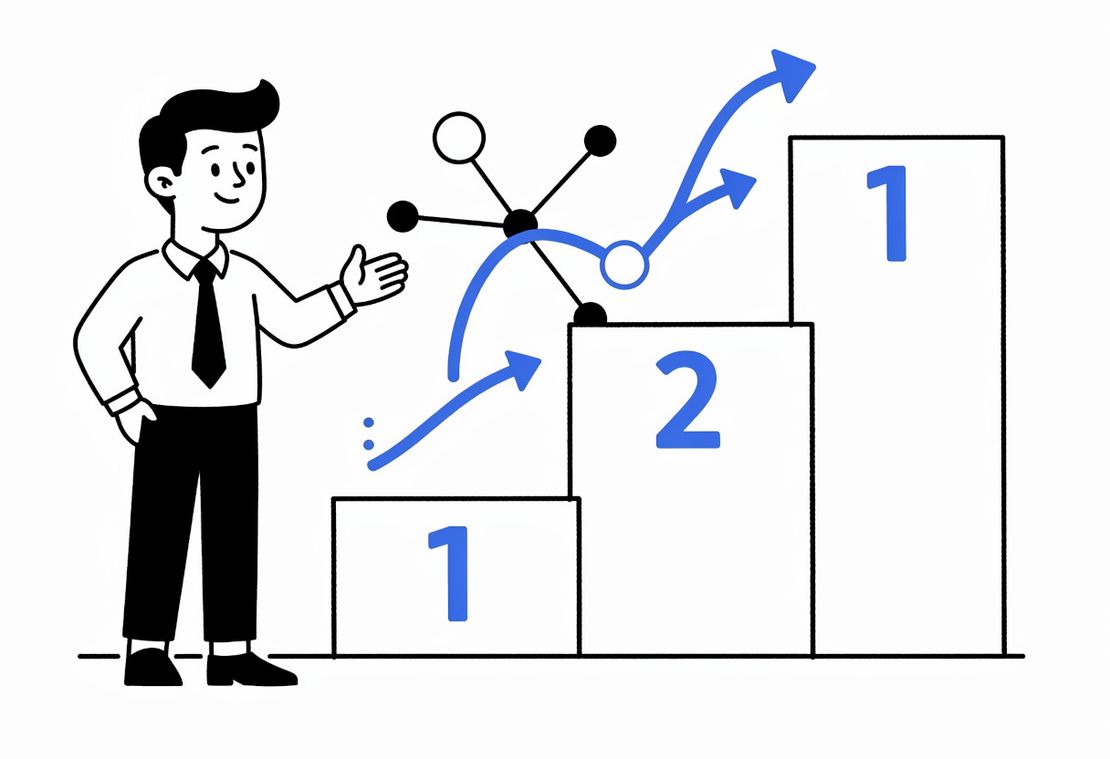
The three-level framework solves this by meeting your team where they are and progressively building capability. Level one is the foundation. Level two is the structure. Level three is the transformation. Miss the foundation, and everything else crumbles.
Level One: The Feature You’re Already Paying For
Level one is the simplest and most overlooked. Someone comes to you with a problem, and the solution already exists as a feature in ChatGPT, Claude, or another AI tool you’re already paying for.
It sounds like this: “I have this problem.” “Did you know ChatGPT can do that? Let me show you.” Five minutes later, they’re saving 30% of their time. No custom development. No complex integration. Just showing someone a capability that already exists.
Most businesses completely underestimate the value at this level. Before you spend $50,000 building something custom, make sure your team is actually using what they already have access to. Level one solutions often deliver 20-30% time savings immediately, with zero development cost.
Here’s what this looks like in practice. An employee is spending hours writing follow-up emails to prospects. You show them they can paste their notes into ChatGPT with a simple prompt and get a perfectly crafted email in ten seconds. Problem solved. Cost: $20/month for a ChatGPT subscription.
Or consider content creation. A marketing manager spending three hours per week repurposing blog posts into social media content. Show them ChatGPT’s custom instructions and project features. Now it takes fifteen minutes. That’s a 91% time reduction with no development, no integration, just learning to use a tool better.
The question to always ask first: “Before we build anything, what can we accomplish with AI tools we already have access to?”
Level Two: When AI Needs to Talk to Your Systems
Level two is when the AI capability needs to connect with your business systems—your CRM, your database, your communication tools. You’re using existing tools like Zapier, Make, or n8n to create the connections, but AI brings context and judgment that traditional automation can’t.
Example: A sales team manually researches every new lead—Google the company, check LinkedIn, look up recent news, find their tech stack, write a summary, add everything to Salesforce. 60-90 minutes per lead. At level two, when a new lead hits Salesforce, automation triggers AI agents to gather all that information automatically. Three minutes later, the sales rep has a complete research brief waiting.
Traditional automation is brittle—if this exact thing happens, do that exact action. AI-powered automation can analyze an email, determine if it’s a refund request or just a general question, assess the customer’s tone, and route it appropriately with a drafted response. That contextual understanding wasn’t possible before.
The key question: “Is this a workflow problem that needs AI’s judgment, or just a task that needs to be automated?”
Level Three: When You Need Custom Code
Level three is when you’ve hit the limits of what existing tools can do. This is custom development territory—building bespoke software tailored to your specific business needs. You need some combination of deterministic code and probabilistic AI working together.
Example: A company with complex training across departments—different materials, compliance requirements, workflows. Can’t be solved with ChatGPT alone or Zapier connecting tools. They build a custom application that ingests training documents, creates department-specific paths, adapts based on employee performance, tracks compliance, and integrates with HR systems.
The critical insight: you can’t make AI do everything. The best level three solutions use deterministic code for structure, workflow, and data management, while AI handles the parts that require understanding, judgment, or content creation.
Poor approach: let the AI agent handle the entire workflow. Better approach: use code to orchestrate the workflow, call AI at specific decision points, use code to validate and route the results. This hybrid approach makes custom AI solutions reliable enough for production.
How the Framework Plays Out
Consider a marketing team transformation. Weeks one-two focused on level one—workshops showing the team how to use ChatGPT for repurposing content, writing email subject lines, analyzing campaign performance. Twenty percent time savings, but more importantly, they started seeing possibilities.
Weeks three-six, they moved to level two. Most painful workflow: content distribution. Writing a blog post, then manually adapting it for LinkedIn, Twitter, email newsletter took hours. They built automation where AI detects new posts, creates platform-specific versions, and queues everything in their scheduler. Distribution time went from three hours to fifteen minutes.
Weeks seven-twelve, they tackled level three. With wins under their belt, they built a custom Content Intelligence Platform that analyzes past performance, monitors competitors, tracks trending topics, predicts what will perform well, and generates content briefs. Result: 40% increase in engagement, 25% reduction in underperforming content.
Notice the progression. They built capability at level one, proved value at level two, and only then invested in level three.
Why the Levels Matter
Start at level one, always. When someone brings a problem that seems to need AI, the first question is: “Can we solve this with features in ChatGPT or Claude?” If yes, start there. Get people using it. Track results.
Second question: “Do we need this AI capability to connect with our other systems?” If yes, explore level two. Build the automation. Measure impact.
Third question: “Have we hit the limits of what tools and automation can do?” Only then consider level three.
This isn’t just about finding the right solution. It’s about building AI capability in your organization progressively. Level one teaches employees how to work with AI, how to prompt, how to think differently about problems. Level two teaches workflow automation and systems thinking. Level three shows what’s possible with custom solutions.
By the time you’re ready for level three, your team is AI-literate. They understand what AI can and can’t do. They can provide better requirements. They can test effectively. And critically, they’ll actually use what you build because they’ve been part of the journey.
The Mistakes to Avoid
Jumping to level three too fast wastes money building custom solutions when a $20/month tool would have worked. But staying at level one too long—manually copying and pasting between AI tools and business systems—leaves 80% of the value on the table.
Not every problem needs AI. If a task doesn’t require judgment, understanding, or content creation, traditional automation is better, faster, and cheaper.
Build WITH your team, not FOR them. Otherwise, you’ll build something nobody uses.
Where to Start
Pick one team. Get them ChatGPT or Claude accounts. Show them five to ten use cases relevant to their work. Give them a week to experiment.
Map your three to five most painful workflows. Ask if AI plus automation could solve them. Pick one. Build it. Measure the impact.
Only after you have level one adoption and three to five successful level two implementations should you consider level three. By then, you’ll know exactly where custom solutions make sense.
Start with level one. You’ll be shocked how much value you can unlock before you write a single line of code.
Want help identifying which level of AI solution makes sense for your specific business problems? Our AI Audit does exactly that—we interview your team, map your workflows, and show you exactly which level one, two, and three solutions will deliver the highest ROI. Learn more about our AI Audit.