There’s a stat that circulates in AI circles: 90% of Gen AI pilots fail inside the enterprise. That’s not because AI doesn’t work. It’s because companies are using it wrong.
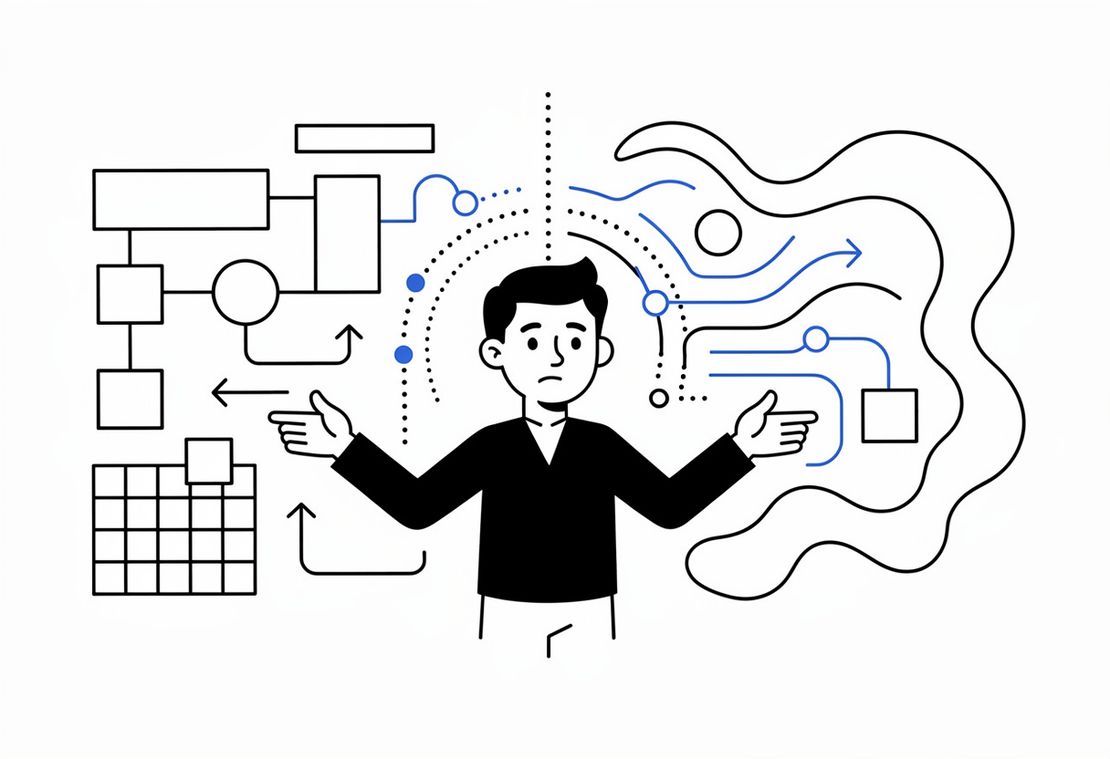
The issue comes down to two words: deterministic and probabilistic. Understanding the difference is what separates AI demos that impress in meetings from AI systems that actually run your business reliably.
Here’s what makes the difference, and why it matters for every AI implementation.
The Problem with Agentic AI
There’s massive hype around “agentic AI”—systems where AI agents autonomously handle entire workflows from start to finish. But the technology isn’t there yet.
Companies build an AI agent to handle customer onboarding. The AI creates accounts, sends welcome emails, sets up integrations, schedules calls. In demos, it looks amazing. In production, it fails 30% of the time. Wrong account type. Missing calendar link. API calls that don’t work because the format changed slightly.
That failure rate might be acceptable for generating email drafts. It’s completely unacceptable for customer onboarding.
What Makes AI Probabilistic
AI is probabilistic. Ask it the same question and you get different answers each time. Directionally accurate, but not if-this-then-that. Ask ChatGPT to write an email, you’ll get different versions. Ask it to analyze sentiment, you’ll get slightly different scores.
That’s AI’s strength. It understands context and nuance in ways traditional software can’t. It can read an email and determine not just if someone’s angry, but the specific type of concern and how urgent it is.
But it’s also why you can’t make AI do everything. Some tasks require probabilistic thinking—understanding, judgment, creativity. Other tasks require deterministic execution—the same result every single time.
What Deterministic Means
Deterministic code is the opposite. If this, then that. One plus one always equals two. Same input, same output, every time.
“If the invoice total is over $10,000, route it to the CFO” is deterministic. Every single invoice over $10,000 goes to the CFO. No exceptions. No variation. No judgment calls.
That reliability is exactly what you need for certain tasks. API calls formatted correctly every time. Data validated against specific rules. Workflows happening in a specific order. Traditional code, database queries, automation platforms—predictable, reliable, boring in the best possible way.
The Hybrid Approach That Works
The most successful implementations combine deterministic code and probabilistic AI. Deterministic code is the skeleton—holds everything together, defines structure, ensures steps happen in the right order. AI is the brain—makes decisions that require understanding, context, or judgment.
The key distinction: don’t use AI for things simple automation can handle. Use AI only where you need contextual understanding, because that’s where automation alone breaks down.
How This Plays Out in Real Systems
Traditional automation is brittle. “If the email contains ‘refund,’ route it to support” works until someone writes “I’m so happy I don’t need a refund.” Your automation just routed a happy customer to the support queue.
AI understands nuance. It evaluates the entire email, determines actual intent, assesses tone, and makes a judgment.
But companies see that AI can understand context and assume it should handle everything. That’s when things break.
Better approach: deterministic code receives the email, extracts basic data, calls the AI with a specific focused task, validates what the AI returns, then executes the routing. The AI analyzes and recommends. The code does the execution.
A Real Example: Lead Qualification
Deterministic code receives the lead from the form, extracts standard fields, validates the data. Then it sends to AI: analyze this lead’s problem description and score them on ideal customer profile fit.
AI reads the context in the prospect’s description, assesses fit based on criteria requiring judgment, returns a score and reasoning.
Deterministic code validates the AI’s response. Is the score between one and ten? Is the recommended sequence valid? If validation fails, flag for human review.
Then code executes the routing—score seven or higher goes to sales, lower goes to nurture. Code updates the CRM. If AI generates a personalized intro email, code sends it and schedules follow-up.
AI handled the judgment call. Code handled everything else. You get AI’s understanding with deterministic reliability.
Why Pure AI Agents Fail
When you make AI do everything, it eventually hits a task that requires perfect reliability. Calling an API where the format must be exact. Updating a database where data types must match. Following compliance requirements where there’s no room for “directionally accurate.”
AI might get the API call right 95% of the time. That 5% failure rate means production issues, support tickets, lost data, angry customers.
The hybrid approach eliminates this problem. Use code for anything that must be 100% reliable. Use AI only where you need judgment, understanding, or contextual awareness.
The Right Way to Think About AI in Workflows
When building custom AI applications, combine deterministic and probabilistic components. A training application: deterministic code handles ingesting documents, managing user accounts, tracking progress, generating compliance reports, integrating with HR systems. AI handles adapting training content based on employee performance, generating questions that match their knowledge level, providing explanations when they’re confused.
Neither component tries to do the other’s job. Hybrid systems that put each technology in its proper role can run reliably at scale.
The Confluence of Automation and AI
AI’s context window and nuance understanding unlocks capabilities automation never had. Before: does it have these keywords or not? Now: evaluate this and tell me which category it fits, then act accordingly.
You’re not replacing automation with AI. You’re augmenting automation with AI’s understanding, while keeping automation’s reliability for execution.
What This Means for Your AI Strategy
When someone pitches you an AI solution, ask how it combines deterministic and probabilistic components. If they say the AI handles everything, be skeptical. If they can’t explain which parts are code and which parts are AI, they don’t understand the distinction.
Don’t make AI do things code should do. Don’t make code do things that require AI’s understanding.
Companies that get this right build AI systems that run reliably. Companies that don’t end up with expensive demos that fail in production.
Deterministic code for reliability and structure. Probabilistic AI for judgment and understanding. Combine them thoughtfully, and you get systems that actually work.
Want AI solutions built with the right combination of deterministic reliability and AI intelligence? Our AI Audit identifies which problems need AI, which need automation, and how to combine both for production-ready results. Learn more about our AI Audit.